
Louis Martin Custom Knives
Tactical Knives for Sale: Handmade Tac Knives & Fixed Blades
A tactical knife is a purpose-designed blade optimized for self-defense, military, and law enforcement use — featuring robust construction, a reliable locking mechanism (for folders), and a blade profile suited for thrusting and utility tasks. Louis Martin tactical knives are hand-forged for maximum durability.
Quick Answer
A tactical knife is a purpose-designed blade optimized for self-defense, military, and law enforcement use — featuring robust construction, a reliable locking mechanism (for folders), and a blade profile suited for thrusting and utility tasks. Louis Martin tactical knives are hand-forged for maximum durability.
Tactical knives demand absolute reliability — no compromises on steel quality, lockup strength, or ergonomics. Louis Martin's tactical blades are built for professionals who depend on their tools. Whether fixed blade or folder, every tactical knife in our lineup is forged, heat-treated, and finished to perform under pressure.
Characteristics & Construction
Blade Profiles
Tactical knives in our lineup feature tanto, clip-point, and double-edged dagger profiles. Tanto points deliver superior tip strength for piercing tasks; clip-points excel at general utility while maintaining a strong, controllable tip.
Steel and Hardness
Tactical applications demand hard, tough steel. Our tactical blades are forged from D2 tool steel (60–62 HRC), high-carbon Damascus, and 440C stainless. D2 provides an excellent balance of edge retention and toughness for professional use.
Handle Ergonomics
Tactical knife handles prioritize grip security under stress. We use G10 composite, Micarta, and textured stag antler — all providing positive grip in wet or gloved conditions.
Carry Options
Fixed-blade tactical knives ship with Kydex or leather sheaths configured for MOLLE, belt, and boot carry. Tactical folders include deep-carry pocket clips.
 Made to Order
 Assorted Lot
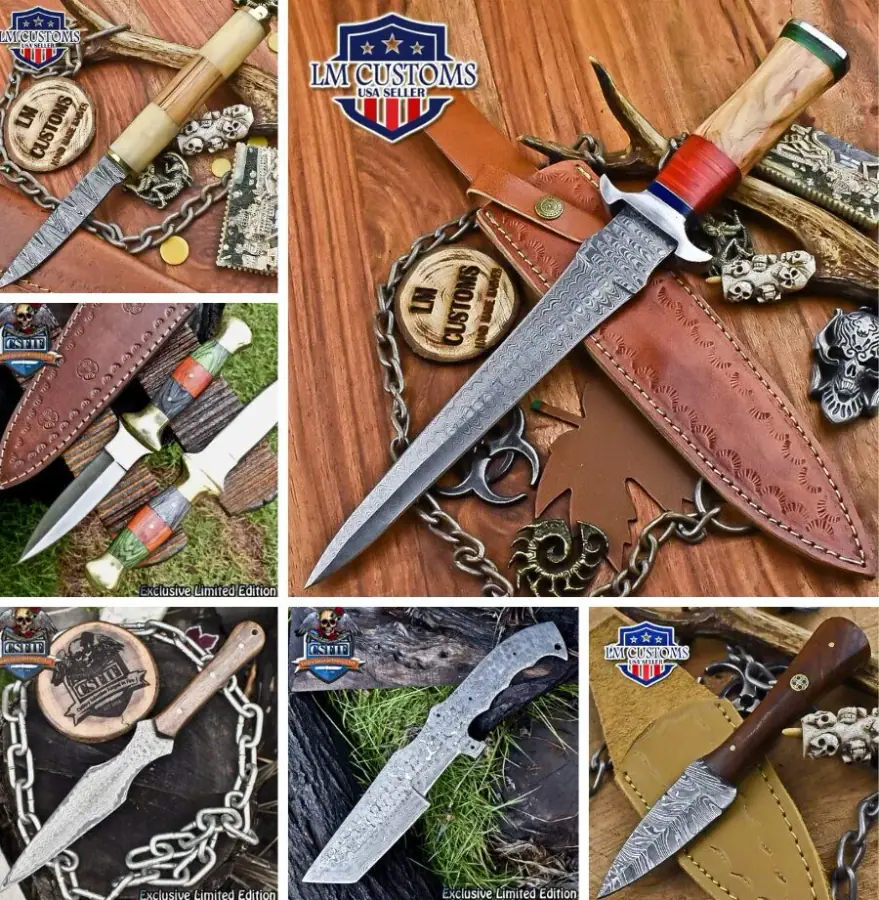
Tactical Knives — 10-Piece Lot
A hand-picked assortment of 10 tactical knife pieces, hand-forged to order in East Northport, NY. Perfect for resellers, gifts, or building a collection. Always available — no waiting on stock. Tell us what you need and we'll confirm options and pricing.
Also available on our eBay store (Top Rated, 110K+ sold), Amazon & Etsy storefronts, in our daily live Whatnot auctions (4.8★, 11,200+ reviews), at gun & knife shows, and for wholesale volume. Carry rules vary: see knife laws by state.
Care & Maintenance
Full care guide →- 1
Field strip and clean
For tactical folders, periodically field-strip the knife (remove the pivot and scales) for thorough cleaning. In the field, compressed air removes dust and debris from the mechanism without disassembly.
- 2
Lubricate sparingly
Over-lubrication attracts grit that becomes abrasive. Use a minimal amount of PTFE-based oil on the pivot and blade contact points. Dry-lube formulations are preferred for dusty environments.
- 3
Test the lock
Before any deployment scenario, test blade lockup by attempting to close the blade against resistance. Any play in the lock requires immediate service.
- 4
Maintain edge geometry
Tactical blades are typically sharpened at 20–25° for durability. Maintain this angle consistently — changing the geometry weakens the edge bevel for the knife's intended use.
- 5
Inspect for corrosion
After exposure to salt water, blood, or harsh chemicals, clean and dry the blade immediately. Even D2 and 440C can surface-rust under prolonged exposure to corrosive environments.
Tactical Knives — Frequently Asked Questions
What makes a knife "tactical"?
What blade steel is best for tactical knives?
Are tactical folding knives as reliable as fixed blades?
Do Louis Martin tactical knives come with Kydex sheaths?
Related Articles
Inquire About Tactical Knives
Tell us your requirements and we'll respond within 24 hours.
Related Knife Types
Not sure what to expect?
See how our process works →Prefer to call?
(631) 812-5595