
Louis Martin Custom Knives
Handmade Skinning Knives
A skinning knife features a curved, upswept blade designed for separating hide from game without cutting the meat. Louis Martin skinning knives are hand-forged with dedicated skinner profiles in Damascus and high-carbon steel for clean, precise field dressing.
Quick Answer
A skinning knife features a curved, upswept blade designed for separating hide from game without cutting the meat. Louis Martin skinning knives are hand-forged with dedicated skinner profiles in Damascus and high-carbon steel for clean, precise field dressing.
The skinning knife is a specialist's tool — its curved blade geometry is designed for one purpose, and it excels at it. Louis Martin's handmade skinning knives give hunters a purpose-built blade that makes the most demanding part of field dressing faster, cleaner, and safer.
Characteristics & Construction
Blade Curvature
Skinning blades feature a pronounced upswept curve that positions the edge parallel to the hide surface as you draw the knife, minimizing the risk of puncturing the hide or nicking the meat. Our skinners range from 3.5 to 5 inch blade lengths.
Drop-Point vs Trailing-Point
We produce both drop-point skinners (controlled tip, versatile) and trailing-point skinners (extreme upswept profile, maximum skinning efficiency, less suitable for field dressing tasks requiring tip work).
Edge Profile
Skinning knives are sharpened with a convex grind — a smooth rounded bevel that slips between hide and tissue cleanly. The convex edge also provides superior durability compared to hollow or flat ground edges.
Handle Position
Skinning work is palm-intensive. Our skinning knife handles are bulged at the palm swell and tapered at the pommel to lock the knife securely in a skinning grip, preventing slippage when the handle is wet with blood.
 Made to Order
 Made-to-Order Lot
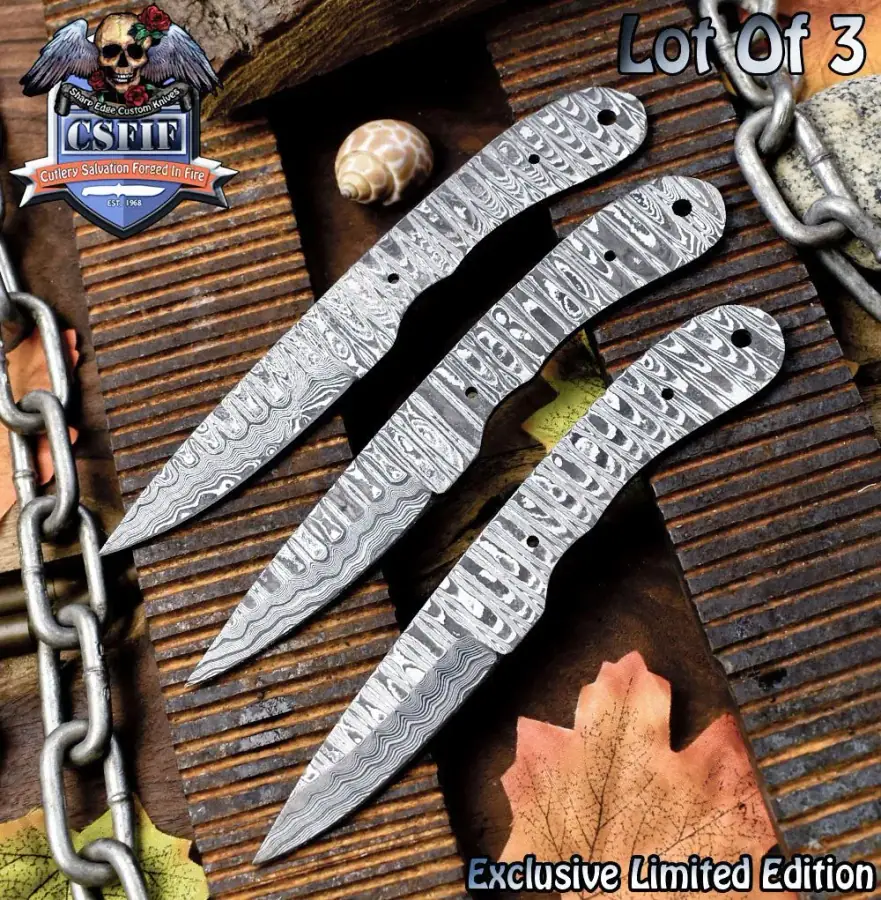
Skinning Knives — 10-Piece Lot
A hand-picked lot of 10 skinning knife pieces, hand-forged to order in East Northport, NY. Choose your steel below: every lot is one of a kind, always available, no waiting on stock.
10% off all lots for a limited time. Free US shipping. 60-day returns. See our shipping and return policies.
Also available on our eBay store (Top Rated, 110K+ sold), Amazon & Etsy storefronts, in our daily live Whatnot auctions (4.8★, 11,200+ reviews), at gun & knife shows, and for wholesale volume. Carry rules vary: see knife laws by state.
Care & Maintenance
Full care guide →- 1
Rinse immediately in the field
Rinse blood from the blade immediately after field dressing. Blood is acidic and will etch and stain unprotected high-carbon and Damascus steel within 10–15 minutes.
- 2
Dry thoroughly
Dry the blade and handle completely before re-sheathing. Moisture inside the sheath is the most common cause of blade rust between hunts.
- 3
Touch up with a strop
A skinning knife dulls rapidly on connective tissue. Carry a leather strop in the field and re-strop the edge between animals for clean, efficient cuts.
- 4
Deep clean annually
Before storage at season end, wash the knife with warm soapy water, dry thoroughly, and apply a heavy coat of mineral oil or gun oil to the blade and handle.
- 5
Oil the leather sheath inside
Apply a thin coat of neatsfoot oil to the interior of the leather sheath annually. A dry sheath can actually scratch the blade finish as the knife is drawn and re-sheathed repeatedly.
Skinning Knives — Frequently Asked Questions
What is the difference between a skinning knife and a hunting knife?
What blade length is best for a skinning knife?
Do I need a dedicated skinning knife or will a hunting knife work?
What is a trailing-point skinning knife?
Related Articles
Inquire About Skinning Knives
Tell us your requirements and we'll respond within 24 hours.
Related Knife Types
Not sure what to expect?
See how our process works →Prefer to call?
(631) 812-5595