
Louis Martin Custom Knives
Handmade Survival Knives
A survival knife is a robust fixed-blade knife designed for wilderness survival tasks: batoning wood, building shelter, fire-starting, food prep, and self-defense. Louis Martin survival knives are full-tang, hand-forged in high-carbon steel for maximum field reliability.
Quick Answer
A survival knife is a robust fixed-blade knife designed for wilderness survival tasks: batoning wood, building shelter, fire-starting, food prep, and self-defense. Louis Martin survival knives are full-tang, hand-forged in high-carbon steel for maximum field reliability.
In a survival situation, your knife is your most critical tool. Louis Martin survival knives are engineered for this reality — full-tang construction that can baton through hardwood without breaking, high-carbon steel that takes and holds a field-sharp edge, and handles that stay secure in cold, wet gloved hands.
Characteristics & Construction
Full-Tang Construction
Every Louis Martin survival knife is full-tang — the blade steel runs the complete length of the handle. This eliminates the weakest point of partial-tang knives: the tang-to-handle joint. Full-tang survival knives can be batoned, pried, and used as a camp axe without risk of handle separation.
Blade Thickness
Survival blades are thick — 4–6mm spine — to withstand lateral stress from prying, batoning, and chopping tasks. This thickness is a deliberate trade-off: slightly more difficult to sharpen but dramatically more durable.
Steel Selection
We use 1080 and 1095 high-carbon steel for our survival knives. These steels are tough, easy to sharpen in the field with minimal equipment, and can be spark-struck with a ferro rod for fire starting.
Spine Features
Many of our survival knives feature a squared, 90° spine for ferro rod striking and a thumb ramp with jimping for controlled push cuts. Some models include a partial saw back.
 Made to Order
 Made-to-Order Lot
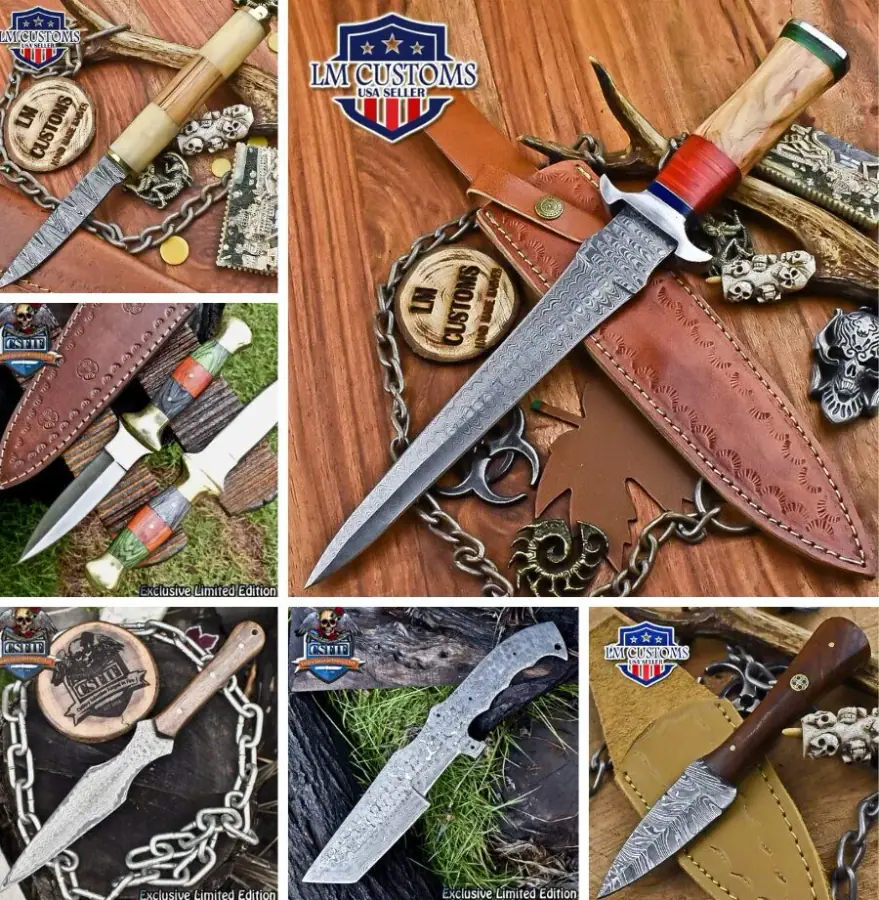
Survival Knives — 10-Piece Lot
A hand-picked lot of 10 survival knife pieces, hand-forged to order in East Northport, NY. Choose your steel below: every lot is one of a kind, always available, no waiting on stock.
10% off all lots for a limited time. Free US shipping. 60-day returns. See our shipping and return policies.
Also available on our eBay store (Top Rated, 110K+ sold), Amazon & Etsy storefronts, in our daily live Whatnot auctions (4.8★, 11,200+ reviews), at gun & knife shows, and for wholesale volume. Carry rules vary: see knife laws by state.
Care & Maintenance
Full care guide →- 1
Dry and oil after field use
High-carbon survival blades rust quickly in field conditions. Clean and oil the blade at every camp stop — your survival knife is useless if it's seized with rust.
- 2
Maintain your ferro rod capability
Keep the spine clean and sharp-cornered. Filing the spine flat maintains the 90° edge required to throw sparks from a ferro rod.
- 3
Sharpen on natural stone
In a true survival situation, fine-grained river stones work as improvised whetstones. Practice sharpening your knife on natural stone so you're not learning this skill when you need it.
- 4
Check handle scales for cracks
Wood and synthetic handle scales can crack under extreme cold. Inspect and re-epoxy any loose scales before extended wilderness trips.
- 5
Season the leather sheath
Condition the leather sheath before any extended field use. A supple sheath is quieter, more water-resistant, and retains its shape around the knife better than dried leather.
Survival Knives — Frequently Asked Questions
What makes a good survival knife?
What is the best blade length for a survival knife?
Can I use a survival knife as a camp axe?
What is the difference between a survival knife and a bushcraft knife?
Can a Damascus knife be a survival knife?
Related Articles
Inquire About Survival Knives
Tell us your requirements and we'll respond within 24 hours.
Related Knife Types
Not sure what to expect?
See how our process works →Prefer to call?
(631) 812-5595