
Louis Martin Custom Knives
Cleaver Knives for Sale: Handmade Damascus & High-Carbon Cleavers
A cleaver knife is a large, heavy-bladed kitchen tool with a broad rectangular blade designed for chopping through bone and dense meat. Louis Martin cleavers are hand-forged in high-carbon and Damascus steel with full-tang construction for maximum chopping power.
Quick Answer
A cleaver knife is a large, heavy-bladed kitchen tool with a broad rectangular blade designed for chopping through bone and dense meat. Louis Martin cleavers are hand-forged in high-carbon and Damascus steel with full-tang construction for maximum chopping power.
The cleaver is the powerhouse of the kitchen — brute force and precision combined in a single heavy blade. Louis Martin's handmade cleavers are forged to deliver authoritative chopping force while maintaining the edge quality that produces clean, controlled cuts through bone, dense root vegetables, and thick meat.
Characteristics & Construction
Blade Weight and Thickness
Our cleavers feature blades 6–8 inches long, 3.5–4 inches tall, and 4–6mm thick at the spine. The mass of the blade does the work — the chopping motion becomes an arm-drop rather than a forced stroke.
Edge Grind
Cleaver edges are sharpened at 25–30° — a higher angle than most knives — to maintain a robust edge that withstands the shock of bone contact. Convex and flat grinds are used depending on the intended application.
Chinese vs Western Cleaver
Western butcher cleavers are heavy and bone-oriented; Chinese cleavers (also called Chinese chef knives) are thinner and lighter, suitable for vegetable prep and slicing tasks. Louis Martin produces both styles.
Handle Strength
Cleaver handles must withstand repeated shock from chopping. Our cleaver handles use full-tang pakkawood, rosewood, and G10 composites — all permanently bonded to the full-length tang with structural epoxy.
 Made to Order
 Made-to-Order Lot
Cleaver Knives — 10-Piece Lot
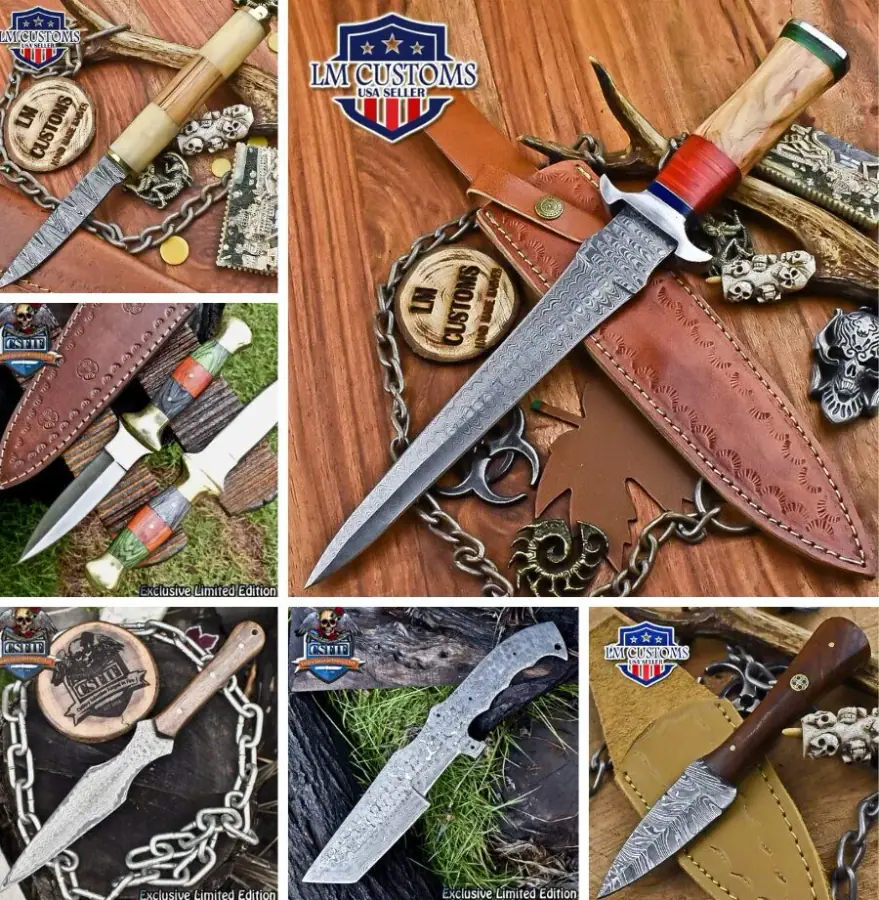
A hand-picked lot of 10 cleaver knife pieces, hand-forged to order in East Northport, NY. Choose your steel below: every lot is one of a kind, always available, no waiting on stock.
10% off all lots for a limited time. Free US shipping. 60-day returns. See our shipping and return policies.
Also available on our eBay store (Top Rated, 110K+ sold), Amazon & Etsy storefronts, in our daily live Whatnot auctions (4.8★, 11,200+ reviews), at gun & knife shows, and for wholesale volume. Carry rules vary: see knife laws by state.
Care & Maintenance
Full care guide →- 1
Hand wash only
Dishwasher heat and moisture cycling will crack even the most durable handle materials over time and cause blade oxidation. Hand wash with mild soap immediately after use.
- 2
Dry immediately
Dry the blade completely — especially the heel corner where water pools — immediately after washing.
- 3
Sharpen at higher angle
Maintain your cleaver's 25–30° edge angle. Lower angles (15–20°) create a thinner, sharper edge that chips on bone contact. A more obtuse angle is appropriate for this tool.
- 4
Use a sturdy cutting board
Cleavers require a heavy wooden butcher block or thick end-grain board. Thin plastic boards flex under chopping force and cause the blade to deflect unpredictably.
- 5
Store on a magnetic strip
Store cleavers on a horizontal magnetic knife strip — the weight of a cleaver in a crowded knife block causes edge-to-edge contact that damages both the cleaver and neighboring blades.
Cleaver Knives — Frequently Asked Questions
What is a cleaver knife used for?
What is the difference between a Chinese cleaver and a Western cleaver?
Is Damascus steel good for cleaver knives?
What cutting board should I use with a cleaver?
Related Articles
Inquire About Cleaver Knives
Tell us your requirements and we'll respond within 24 hours.
Related Knife Types
Not sure what to expect?
See how our process works →Prefer to call?
(631) 812-5595