
Louis Martin Custom Knives
Handmade D2 Steel Knives
D2 tool steel knives are high-carbon, high-chromium blades renowned for exceptional wear resistance and edge retention. Louis Martin's D2 knives are hand-ground from D2 bar stock, heat-treated to 60–62 HRC, and fitted with custom handles — producing working knives that stay sharp through demanding use.
Quick Answer
D2 tool steel knives are high-carbon, high-chromium blades renowned for exceptional wear resistance and edge retention. Louis Martin's D2 knives are hand-ground from D2 bar stock, heat-treated to 60–62 HRC, and fitted with custom handles — producing working knives that stay sharp through demanding use.
D2 tool steel has earned a devoted following among serious knife users for one reason: it holds an edge longer than almost any comparable steel. At Louis Martin Custom Knives, we work D2 bar stock into hunting knives, tactical blades, and utility cutters that perform under hard daily use. Heat-treated to 60–62 HRC in our East Northport workshop, every Louis Martin D2 knife is hand-ground to a precise bevel and fitted with the same premium handles available on our Damascus line.
Characteristics & Construction
Steel Composition
D2 is a high-carbon (1.4–1.6% C), high-chromium (11–13% Cr) tool steel. The chromium content places D2 in a semi-stainless category — significantly more corrosion-resistant than plain high-carbon steel, though not as rust-proof as true stainless alloys like 440C. Originally developed for industrial cutting tools and dies, D2 brings that wear-resistance into the knife world.
Hardness & Edge Retention
Heat-treated D2 reaches 60–62 HRC — among the hardest working knife steels available. This delivers outstanding edge retention: a well-maintained D2 blade stays sharp through fieldwork, food prep, and daily carry that would dull softer steels. The trade-off is that D2 is less forgiving of lateral stress than lower-hardness steels.
Handle Materials
Louis Martin D2 knives are fitted with the same handle options available across our custom line: stabilized walnut, rosewood, and cocobolo, G10 composite, Micarta, stag antler, camel bone, and brass guard fittings — each selected and mounted by hand to suit the knife's intended use.
Grind Profiles
D2 blanks are hand-ground in hollow, flat, or convex profiles at our East Northport workshop. Hollow grinds optimize slicing and kitchen performance; flat and convex grinds provide superior edge durability for hunting, outdoor, and hard-use tactical applications.
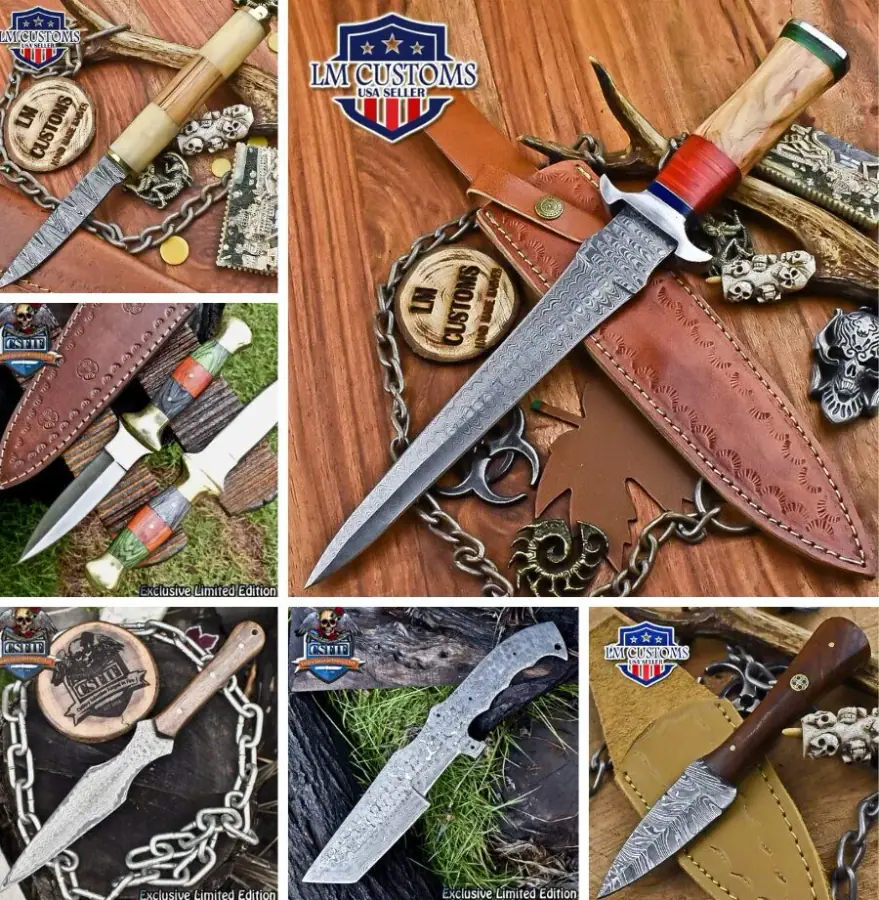 Made to Order
 Assorted Lot
D2 Steel Knives — 10-Piece Lot
A hand-picked assortment of 10 d2 steel knife pieces, hand-forged to order in East Northport, NY. Perfect for resellers, gifts, or building a collection. Always available — no waiting on stock. Tell us what you need and we'll confirm options and pricing.
Also available on our eBay store (Top Rated, 110K+ sold), Amazon & Etsy storefronts, in our daily live Whatnot auctions (4.8★, 11,200+ reviews), at gun & knife shows, and for wholesale volume. Carry rules vary: see knife laws by state.
Care & Maintenance
Full care guide →- 1
Wipe clean after each use
Remove debris, moisture, and food acids from the blade with a soft dry cloth after every use. D2 is semi-stainless, not fully stainless — exposure to acids and prolonged moisture will eventually cause surface rust or staining if the blade is neglected.
- 2
Dry completely before storage
Ensure the blade and handle are fully dry before sheathing or storing. Moisture trapped inside a sheath is the primary cause of rust on D2 knives. Store in a breathable leather sheath or on an open magnetic strip rather than in a closed plastic sleeve.
- 3
Apply a light oil coating
After cleaning, wipe a thin coat of food-grade mineral oil or camellia oil across the blade. This creates a moisture barrier and maintains the finish. D2 requires less frequent oiling than plain high-carbon Damascus but benefits from regular treatment.
- 4
Sharpen with a diamond or ceramic stone
D2's high hardness (60–62 HRC) means standard aluminum-oxide whetstones cut slowly. Use a diamond-coated whetstone (1000/3000 grit) or quality ceramic rod for efficient sharpening. Maintain a consistent 15–20° angle per side for the best cutting performance.
- 5
Store in low humidity
Store D2 knives in a dry environment — a knife block, magnetic wall strip, or oil-treated leather sheath. Avoid humid areas and sealed plastic storage. Even semi-stainless steel develops rust under persistently damp conditions.
D2 Steel Knives — Frequently Asked Questions
What is D2 steel?
How does D2 compare to Damascus steel?
Does D2 steel rust?
What is D2 steel best used for?
What hardness does Louis Martin heat-treat D2 to?
How do I sharpen a D2 knife?
Can I get a D2 knife with a custom handle?
Related Articles
Inquire About D2 Steel Knives
Tell us your requirements and we'll respond within 24 hours.
Related Knife Types
Not sure what to expect?
See how our process works →Prefer to call?
(631) 812-5595